You’re reading CX Stories, a newsletter about customer experience innovation. If you want to join the 6000+ lovely people who receive it every month, just click the button below.
A couple of years ago, I needed to know quite urgently whether I was insured to drive my Mum’s car. I’d got the train to her house, but had to unexpectedly go and see her in the hospital.
I called my car insurer, and punched in the combination of numbers that I thought would get me to the answer. A cheery automated voice answered:
Did you know, you can do this online? Please visit our website.
Well, yes, I did know I could do it online, because it’s 2023 and I’m aware of the existence of the internet.
I tried again. Different combination of numbers. Same response. And again. And again.
Eventually, after ten minutes, I got through to someone and explained the situation. After a big, long sigh, he gave his reply:
You know all of this information is in your policy booklet?
Yes, but I’m a normal human being so I don’t carry my policy booklet around with me everywhere I go
This is a great example of a contact that, in the near future, will be made much better by AI. No opening hours, no wait times, just straight through to ‘a person’ who should be able to answer my question immediately.

With all the excitement around AI Agents though, there’s a danger that organisations start to see all contact with customers as something to be reduced or automated away. There’s a very real chance that that becomes brain-crushingly frustrating for customers, and leaves the organisation without any sort of distinction from competitors. But more than that, there’s also a very real chance of companies missing out on some fantastic opportunities.
At the moment, automation of customer contact generally means two things.
- Go find it yourself on our website
- Try your luck with one of our chatbot gatekeepers, seemingly there to help, but actually there to encourage you to go find it yourself on the website
In the near future, you’d expect far more sophisticated chatbots to be able to effectively answer 80% of customer queries, whether that’s surfacing the information from the website themselves, or using the customer’s data to give a far more relevant answer.
But what about the other 20% that’s left?
These will likely be the most complex, the most delicate, or the most emotional moments; the ones that are high importance to customers. They’ll also be the ones that will give the company an opportunity to be there when needed, to build trust and deepen the relationship – and potentially, to involve a living, breathing human.
The risk of annoyance is high, so organisations need to make considered decisions about how to handle different customer contact, understanding the value that each type of contact brings, for them, and for their customers:
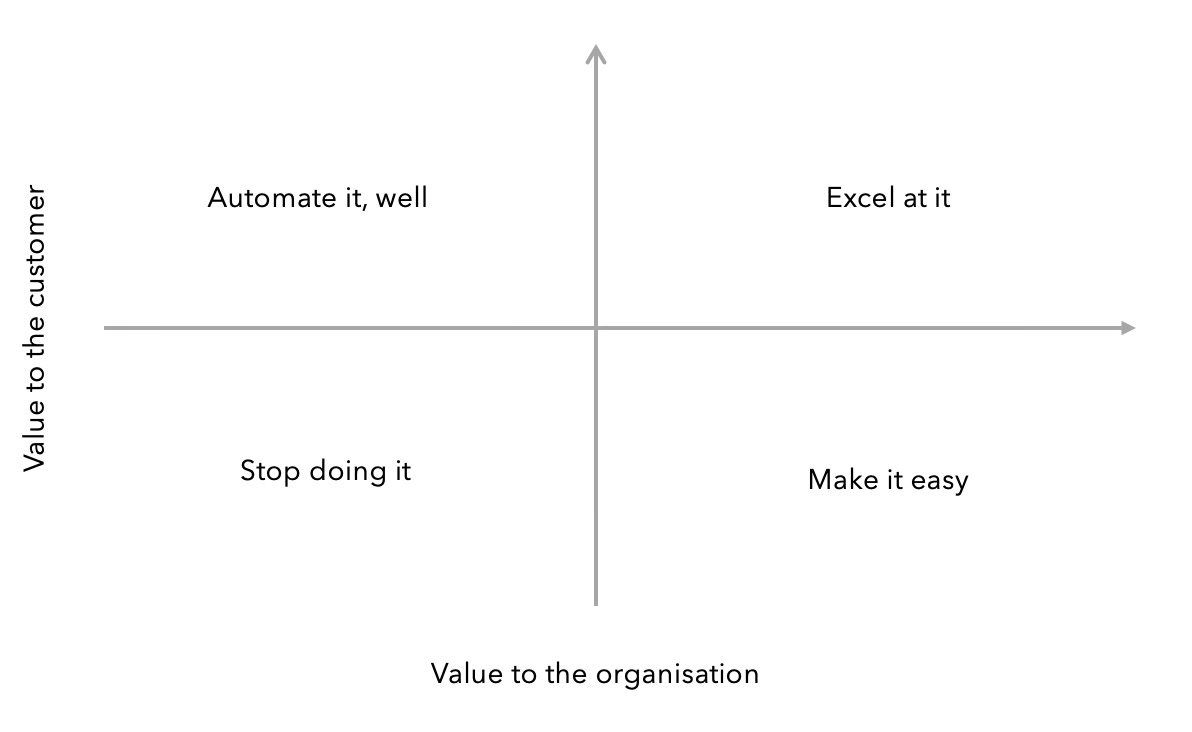
- Low value to both? Just get rid of it, stop doing whatever is causing it.
- Valuable to the organisation, but not the customer? Make it as easy as possible, so the customer is more likely to do it
- Valuable to the customer, but not the organisation? Automate these – but well, and with a safety net if something goes wrong.
- Valuable to both? Excel at it. And this is where the humans come in.
Of course, it would be much better if the investment in AI was being spent on stopping problems happening in the first place, rather than replacing the people there to fix them. But that’s another conversation for another time.
So until AI helps us eliminate all customer problems (spoiler alert: there will always be customer problems), organisations are going to need to thinking carefully about which contacts to automate, and which to keep a real human for.
Conversely, this means that whilst organisations are spending money investing heavily in new AI technology, they also need to be investing heavily in their people.
Because the contact that will be left for real people to deal with will be the contact that requires the most empathetic, most highly skilled, most competent colleagues. The kind of stuff that AI just can’t do.
Thanks for reading this article, I really hope you enjoyed it. You can subscribe to my monthly newsletter below, find me in picture form on Instagram @johnjsills, or in work mode at The Foundation and LinkedIn.
 johnJsills