You’re reading CX Stories, a newsletter about customer experience innovation. If you want to join the 6000+ lovely people who receive it every month, just click the button below.
A few years ago, in the heyday of their 2-for-1 voucher offer, Jamie Douglass sent me the most brilliant story about Pizza Express:
‘I just went to the local pizza place and tried to use one of their 2-4-1 vouchers, but the guy insisted he could only accept the voucher if you booked the table over the phone. So I went outside and called them. The same guy picked up the phone and conducted the entire conversation 100 per cent straight looking at me in the eye through the glass door. I booked the table for five minutes later, walked back in, sat
down, and used my voucher as if this was completely normal.’
That’s not really relevant to today’s story, but it makes me laugh every time.
I never used to go there at all. It almost seemed the most chain of chain restaurants: identikit interior, good-enough food, standard-10%-tip service.
Then children appeared in my life, and I’ve grown to love it.
Because Pizza Express really, really knows their family audience – and crucially, they’ve made a clear strategic choice as to how to be meaningfully distinct, and earn more customer decisions in their favour.
When you have little people in your life, that identikit interior and standard service are a huge benefit. You know exactly what you’re going to get when you want to take the kids out for food, but didn’t want to remortgage the house or collapse in tears in the process.
For example, they really think about where to sit you. A bit like airlines, they know the best place for families with small children to sit is near other families with small children.
Partly, this is to help those without children avoid the risk of being caught in the carbonara crossfire. But it’s also good for parents, who tend to be slightly more relaxed about misbehaving children when other parents of misbehaving children are in close proximity, ready with a sympathetic smile and a ‘we’ve all been there’ nod.
They also know that the gap between a child ordering their food and receiving their food is the most dangerous and stress-inducing time any parent can face. (Shortly after having children, we had lunch at a local cafe. The waiter brought over the adults’ food first. It’s fair to say the five minutes before the kids’ food arrived were the most stressful of my life up to that point. The locally handmade sausage roll didn’t survive the encounter.)

Whereas, within about a minute of ordering at Pizza Express, the kids have the classic dough balls + veg sticks in front of them, satiating their hunger, calming their nervous system, and reducing the decibel level in the restaurant by a factor of about fifty.
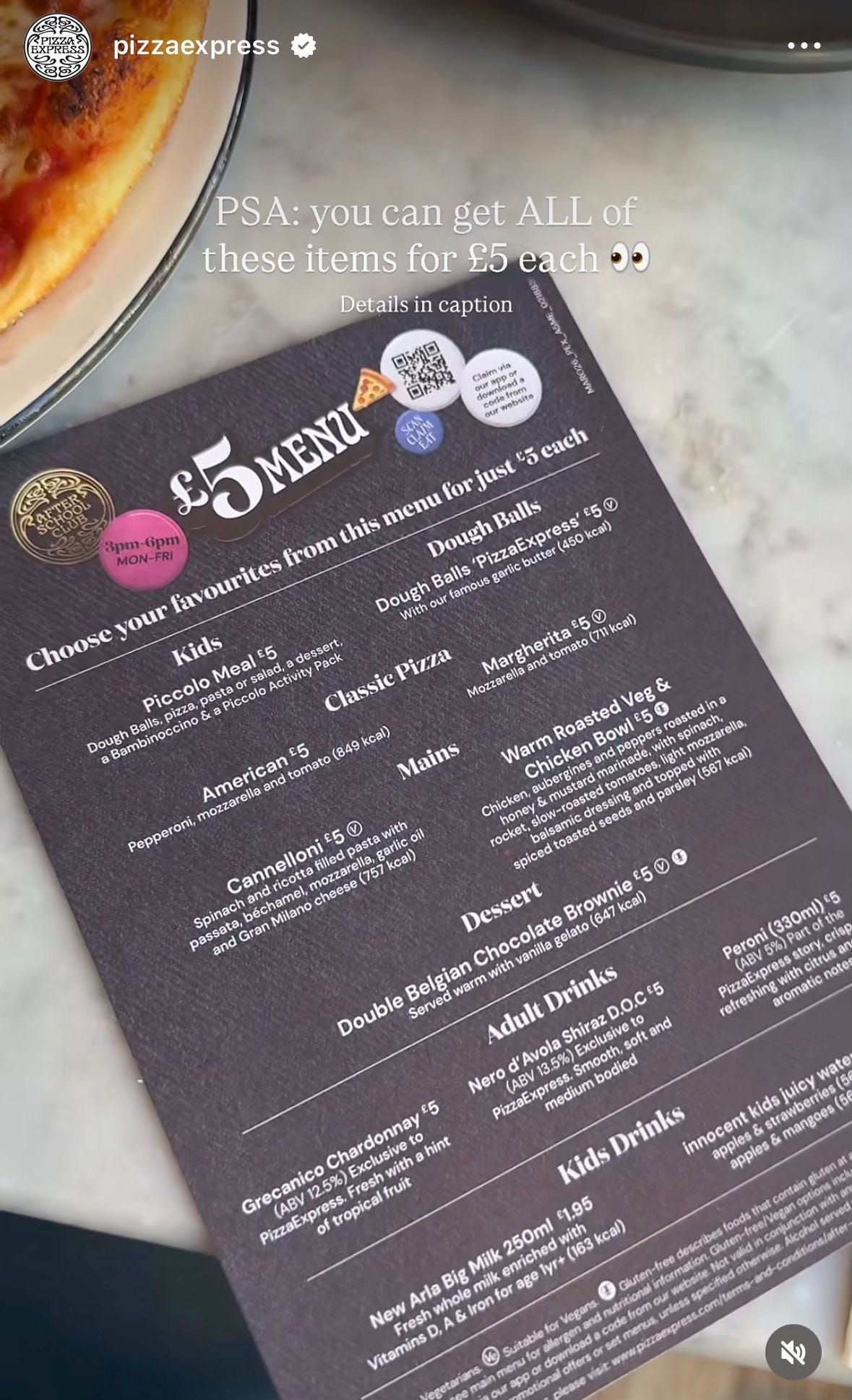
Finally, they know that taking the family out for a meal isn’t quite as cheap as it used to be. So, with their audience very clearly in mind, they’ve recently launched their ‘After School Club’ menu, offering a range of dishes for £5 each, on weekdays between 3pm and 5pm.
Now, this may sound a bit like a party political broadcast for Pizza Express at the moment, but there’s a reason I like their approach, over and above it just being a good proposition for families.
They’ve made a decision.
Lots of organisations think they have a customer strategy, but what they really have is a load of segments that cover nearly the whole population, and a whole load of ideas that could work for all of them.
A strategy can only be a strategy if you’re making deliberate choices: choices about which customers you’re for; about which customer decisions you want to earn; about how you’re going to be meaningfully distinct from the competitors.
Without those choices, it’s near-impossible to prioritise, with the company instead doing lots of well-meaning but piecemeal activities. And if an organisation isn’t meaningfully distinct, it’s hard to become the customer’s default choice, to be the habit, to avoid a race to the bottom on price.
We’re coming to the end of our Pizza Express phase now, so won’t be going there anywhere near as much in the next ten years as we have in the last. But my kids, entering their teenage years, might.
Should they still try to appeal to me, an empty-nester with a bit more disposable income? Possibly, but probably better not to. Because there’s lots of parents, lots of people with kids aged 0-10, lots of teenagers going on their first dates. Even with birthrates falling, that audience is going to be there for a long time to come yet.
Put simply, to earn more customer decisions, it’s better to make a choice and be meaningfully distinct than avoid the decision and be distinctly average. And having crayons and colouring pads at the ready always helps, too.
Thanks for reading this article, I really hope you enjoyed it. You can subscribe to my monthly newsletter below, find me in picture form on Instagram @johnjsills, or in work mode at The Foundation and LinkedIn.
 johnJsills