You’re reading CX Stories, a newsletter about customer experience innovation. If you want to join the 6000+ lovely people who receive it every month, just click the button below.
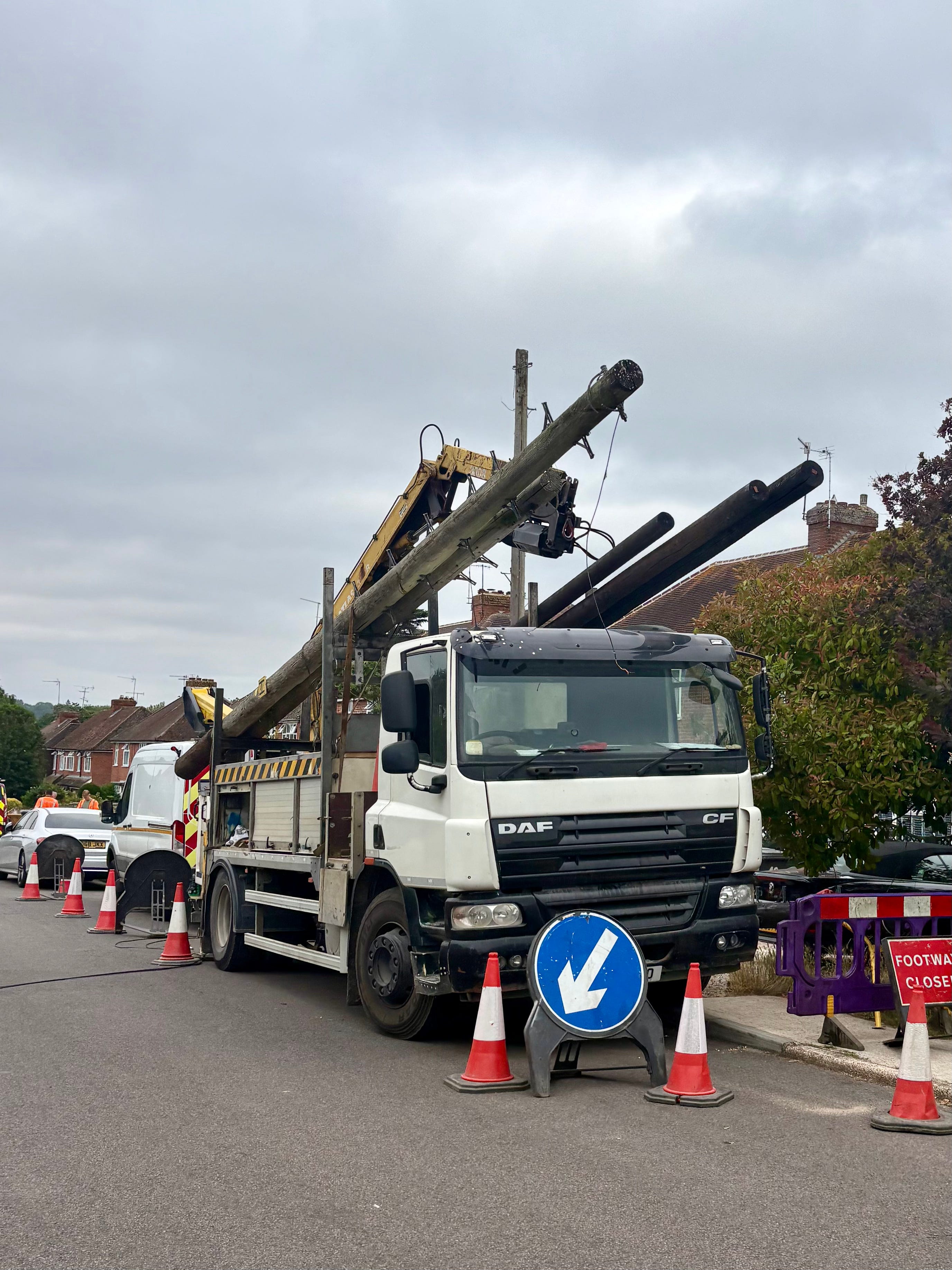
You know what it’s like. One moment, you’re on a Teams call, chatting away like normal. The next, the pole which connects your broadband has been ripped out of the ground and is sat on the back of a lorry.
Last time out, I wrote about one of the best customer experiences I’d had, how brilliantly and easily Remarkable had dealt with a broken pen.
A few days later, shortly after the new pen arrived, I had one of the worst – as if the pen’s arrival heralded some kind of cosmic karma to pay penance for such good service.
Outside my house, I spoke to one of the friendly workmen to ask what was happening:
“I’m guessing they haven’t told you either? Seems like no-one has been told. Need to replace the pole, it’ll be fine after that”
Of all the possible things I thought might happen next, I didn’t expect it to end up with one of the most ludicrous webchats I’ve ever had – one that shows the importance of being proactive with your customers, and why organisations that give a good experience are also those with the best control on their costs.
As regular readers will know, it’s not the first time various wires have been unceremoniously ripped from my house.
Back in the house and with my hotspot overheating, I braced myself to run the gauntlet of trying to get through to my broadband provider.
As expected, the bot didn’t want to let me speak to a human.
And as expected, as soon as I pretended to be a new customer, the bot was happy to put me through to someone (or at least it claimed to. You can make your own mind up…)
Things started well, with me explaining that I was, actually, already a customer, and what the issue was.
No problem, said the agent. Just let me know the email address associated with the account and we’ll fix it.
This didn’t go to plan…
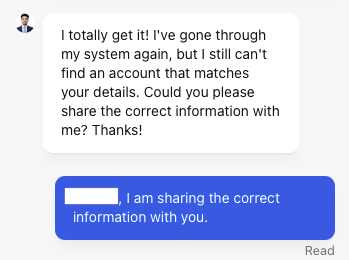
Slightly annoyed by the suggestion I was getting my own email address wrong, I sent a screenshot of an email between me and the company. This was quickly rebuffed – alongside a subtle suggestion that I was maybe faking the whole thing.
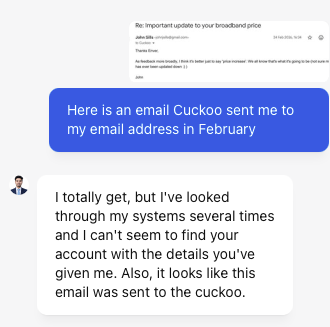
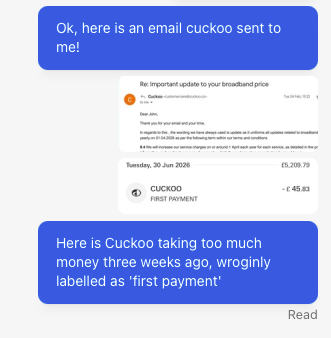
Message after message went back and forth, asking me for the ‘correct’ email address – something I was now seriously starting to doubt myself. I sent another screenshot, of an email they sent me, and of my last direct debit payment.
It was at this point I realised something was up: it was double the usual amount, and said ‘first payment’, despite having been a customer for years. The pole was becoming a distant memory.
This went on, without progress, for twenty minutes. Then, without warning, I was in! And a retrospective explanation for the issue which, y’know, may have been helpful for us both to know at the start.
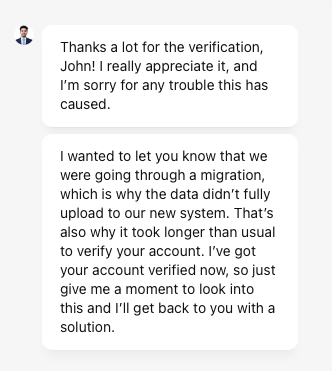
Take deep breathes, it’s progress at least. Right, where were we? Ah yes, the broadband pole…
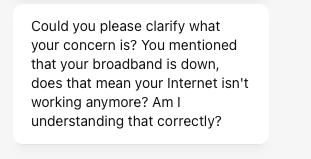
I reminded him of the fairly urgent issues, and was rewarded with a compliment on my curiosity.
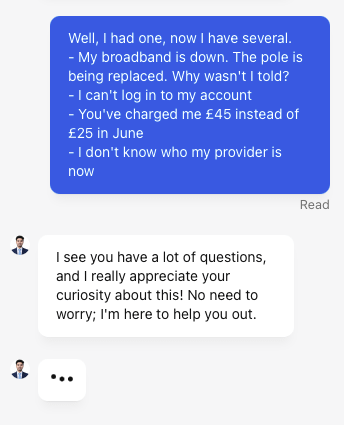
I was told that, before we could keep up our rapid pace of progress, I’d have to re-register my account. To be fair, this was done fairly quickly (in comparison to the 85 years it felt like I’d spent on the chat so far), and broadly correctly – just put in the wrong name, which was also spelt wrong for good measure. Close enough.

But no worries!
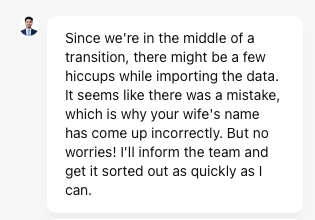
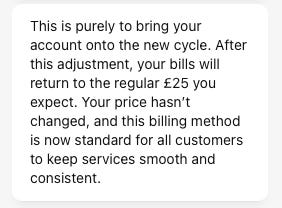
We then get to the whole double-payment thing. Is that something I was allowed to worry about? It seems not. The change was just to keep things ‘smooth and consistent’, which, it’s fair to say, was not my overriding feeling of the chat so far.
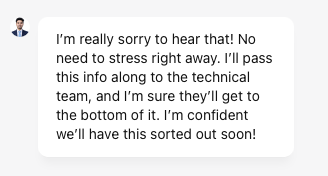
Back to the real issue, no working broadband, wires strewn across the street. But again, my emotions are wrong – no need to stress.
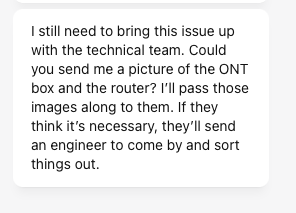
Although, I’ll admit to feeling some stress when I was asked to send a photo of my broadband router, which was clearly not the problem. And that stress maybe increased just a notch at the suggestion an engineer may need to come and visit.
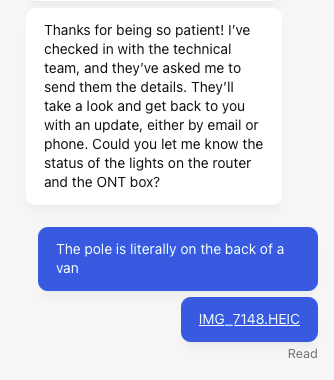
I bravely suggested the issue might be the whole pole-on-the-back-of-a-lorry thing.
Then I asked the question I had at the start of all of this – why wasn’t I told this was going to happen? Of course, the migration… So if they’d had my correct email, it would have all been ok.
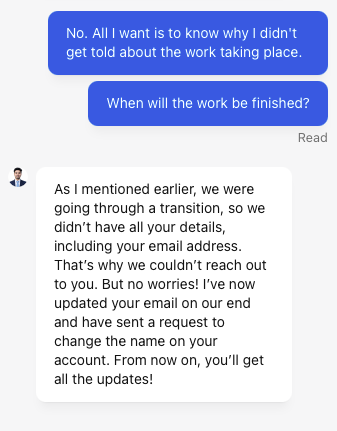
Except, they didn’t know either.
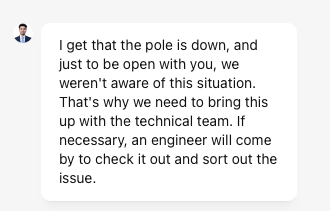
An hour in, I finally get to ask the question I wanted answered in the first place. And the veins on the side of my forehead exploded when I realised, after all that, this agent knew no more than the workmen I’d already spoken to.
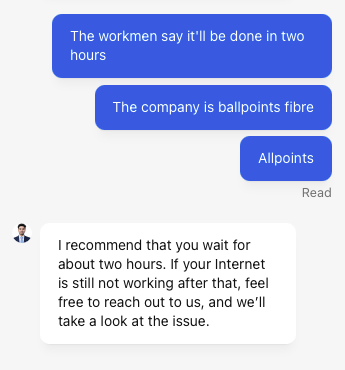
As with any webchat, there was still time for one more question…
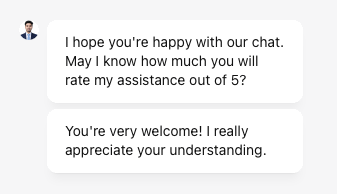
I try to avoid writing stories about experiences like this. I know it can come across as moany, sarcastic, or ungrateful. And if the agent is a real person – a big if – it’s not his fault; he’s let down by poor systems, processes, and training.
It’s also hard to come to a clever conclusion that’s more than ‘don’t be this rubbish’.
But really, this is a story about proactivity, proving the point that bad customer experience is expensive to provide.
If they send an email about the pole being down, I don’t get in touch.
If they send an email about the Direct Debit payment, I don’t get in touch.
If they send an email about not having my email… well, I’ll let them off that one. But maybe don’t lose it in the first place. Or tell me about the migration.
Just on my street, I know several people who got in touch. Multiply that by the whole customer base, across days and weeks of similar issues, and the company is spending a fortune resolving queries that never needed to occur.
It’s more proof that giving a good experience isn’t just good for customers; it saves companies a lot of money, too. And maybe stops an aneurism or two along the way.
Thanks for reading this article, I really hope you enjoyed it. You can subscribe to my monthly newsletter below, find me in picture form on Instagram @johnjsills, or in work mode at The Foundation and LinkedIn.
 johnJsills